CALIFORNIA NATIVE AMERICAN Bows and Arrows Documentary professional pictures photos, field museum research how to information about expert Indigenous bow makers bows and arrows archery of Alta California.
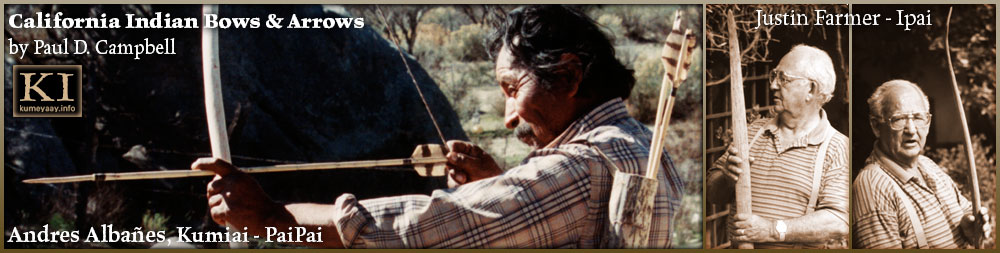
Andres Albanes, Kumeyaay - PaiPai Indian archer and traditional bow and arrow maker, Santa Catarina indigenous community, Baja California, Mexico, 1990s.
CALIFORNIA INDIAN BOWS ARROWS
Para Español Traduzca esta página inglesa al español
Webmaster Forward:
- KUMEYAAY.INFO is thrilled to feature the photographs and research of PAUL D. CAMPBELL, a dedicated field researcher, writer and photographer who is well known among the national and international museum community for his important work on the California Indians. Paul is a virtual authority on traditional California Indian survival techniques, having established personal relationships with countless traditional Native American elders in Baja and Southern California, documented and researched their ageless survival and hunting methods in the California high deserts, coastal, river and mountain areas.
Mr. Campbell has just released his newest book, EARTH PIGMENTS AND PAINT: MEANING AND TECHNOLOGY.
This fully-researched book will include all facets of Native California pigments and paint, including physical, social, spiritual — in great detail — and reveals about how the Indians turned yellow pigment red, and how the aborigines made blue from white gypsum and black charcoal, and it will give many other recipes for Indian paint.- The book will also discuss the origin of CAVE ART in California and will include the latest atomic accelerator testing of the ancient pigments used by California Indians for eons.
Native American Bows & Arrows Arrowheads original content courtesy of PAUL D. CAMPBELL, provides KUMEYAAY.INFO guests with an experienced field researcher's look into how the Native American California Indians made their rare hard to find willow bows, specialized hunting arrows, hardwood arrowheads, and stone Indian arrowheads for hunting, target and sport shooting.
From start to finish, Paul Campbell documents Kumeyaay Kumiai and PaiPai Pai-Pai Indians gathering the raw natural materials, shaping, constructing and using the primitive weapons of the original California inhabitants, including how to gather natural indigenous bow-making materials like black willow, owl feathers fletching redtail hawk sinew. Includes step-by-step instructions how to make an Indian bow in one day.
For Paul's complete how to make information about aboriginal primitive museum-grade Indian bows, arrowheads and arrows making, including detailed history about California Native American bows arrows, please see his highly-recommended book:
 REVIEW THIS BOOK
BUY THIS BOOK NOW on amazon.com Photos and text courtesy of Paul D. Campbell, author of SURVIVAL SKILLS OF NATIVE CALIFORNIA, where the KUMEYAAY.INFO excerpted material was originally published. Paul's book features living (and deceased) Native American California Indigenous people of the greater San Diego area, and details their traditional weapons used for hunting and aboriginal survival methods...Paul's book is available for sale at Shumup Ko Hup Indian store WEBSITE HOWKA.COM
 REVIEW THIS BOOK (With Buy Now Info Link to Amazon.com)
Native American bows, arrows, fletching and arrowheads in this California tribal bow section are about primitive hunting and war weaponry of the Yuman and Shoshonean Indians of Southern California, northern Baja CA, Mexico, and southwest Arizona. These aboriginal weapons include the bows and arrows of the Kumeyaay Kumiai, PaiPai, Quechan, Maricopa, Mohave Mojave, Ipai Tipai, Kiliwa, Yavapai, Havasupai, Hualapai, Indigenous peoples of North America; including the Luiseño Luiseno, Serrano, Juaneño Juaneno, Chemehuevi, Gabrielino and Cahuilla nations.
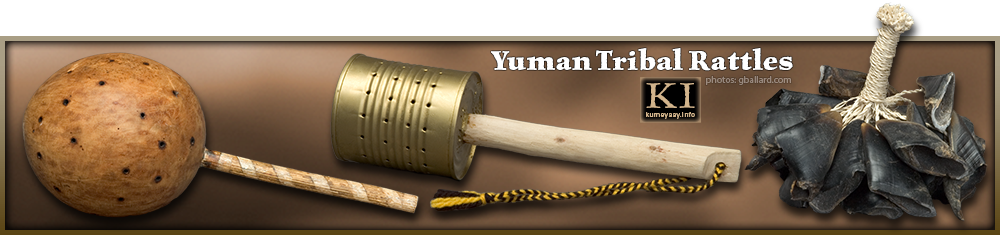
Hand Rattles of the Kumiai-Kumeyaay-Diegueño-Ipai-Tipaay, Bird Singing, Bird Dancing of the Yuman tribes:
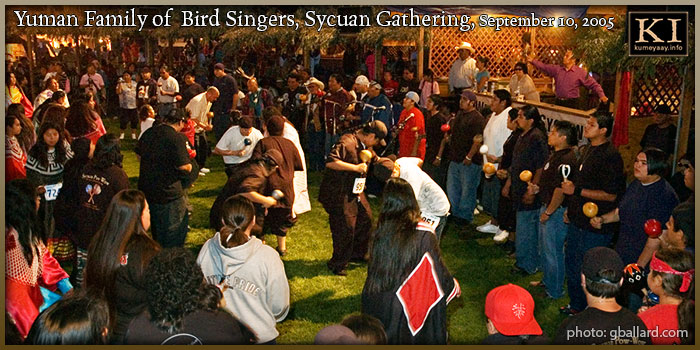
Local Indian band hosts a large night-time gathering of Yuman tribal peoples visiting from California, Mexico, Arizona -- playing their traditional gourdrattles and singing tribal songs. MORE

ANTIQUE KUMEYAAY RATTLE: Two painted red birds with white wings hand painted on a gourd rattle in the 1940s by Isabel Thing, Kumeyaay, mother to Jane Dumas (Jamul) and grandmother to Daleane Adams-Thing (Jamul). Jane and her Kumeyaay mother, Isabel, were both medicine people. Access to take studio photos of family cultural heirlooms granted by kumeyaay.info contributor Jane Dumas. MORE INFO
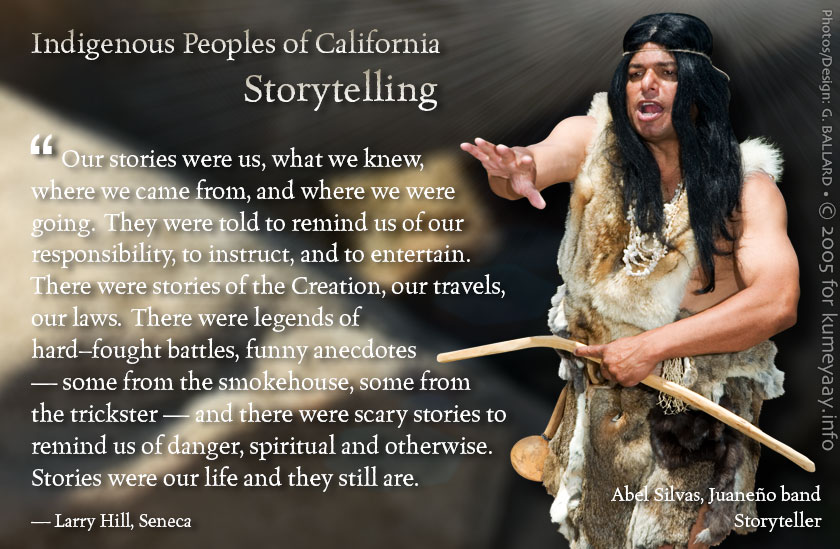
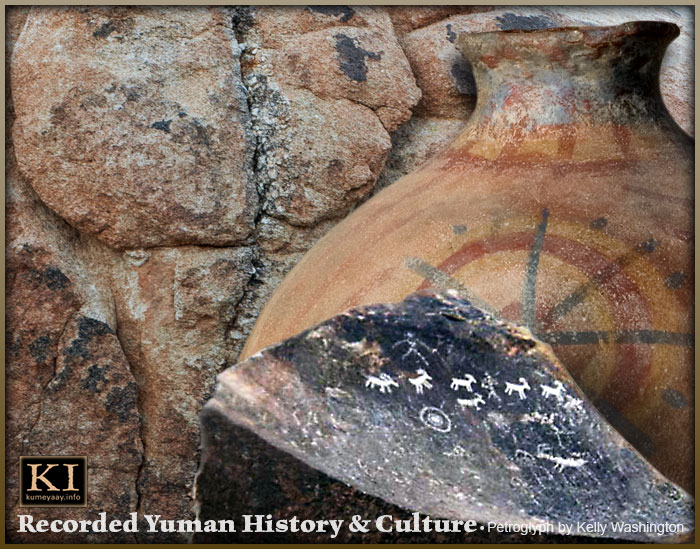
The Yoni granite sculpture background in this composited graphic was photographed at Indian Hill, Anza Borrego Desert State Park in 2004 -- notice the dark aged paint, it must have been all painted up in original celebrated form. The rare Polychrome olla was found in the late 1900s in western Imperial County. The Petroglyph rock was photographed by Kelly Washington in 2004 at Vii Kwame, a sacred mountain for many of the Yuman tribes.
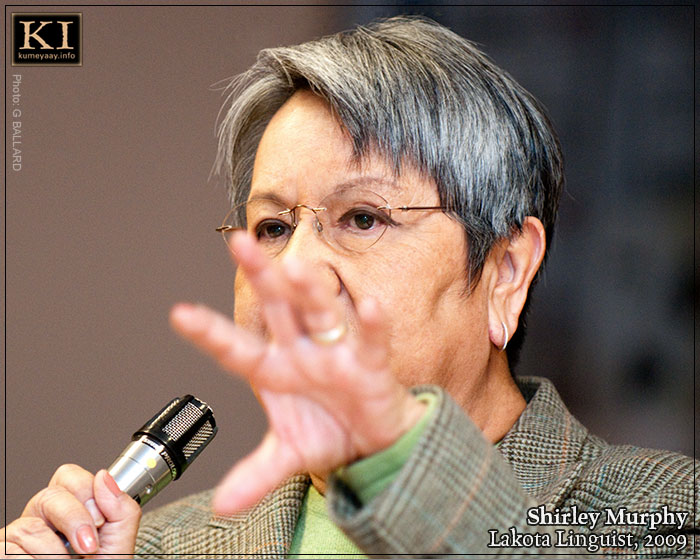
KUMEYAAY LANGUAGE DEPARTMENT...
The Kumeyaay tribe has been categorized within the so-called Hokan Delta-California group of the Yumans.
"Hokan" references an academically-defined group of about a dozen languages spoken mostly by Yuman Native American Indian tribes in Arizona, California, and Baja California, Mexico.
The Hokan group includes Cocopah, Kumeyaay, Maricopa, Quechan, Mohave, Pai Pai, Yavapai, Havasupai, and Hualapai.
The Kumeyaay language spoken by today's Kumeyaay speakers include a northern dialect (Iipay) and a southern dialect (Tiipay).
 BUY similar Native American bows and arrows world-wide at Shumup Ko Hup Native American Indian store and gift shop of the California Indians of Southern California, northern Baja California, Mexico, and southwest Arizona, including linked artists directory containing bow-making Indian artists biographies, photos pictures catalogs of their authentic ethnographic arts and crafts for sale.
 |
 |
Kumeyaay Indians Home • About Us • Mission Statement • Press Kit • Contact Us