|
 |
|
|
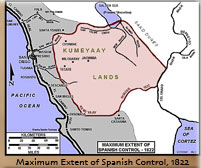
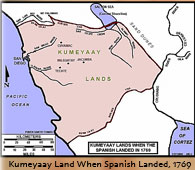
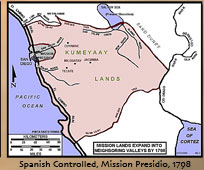
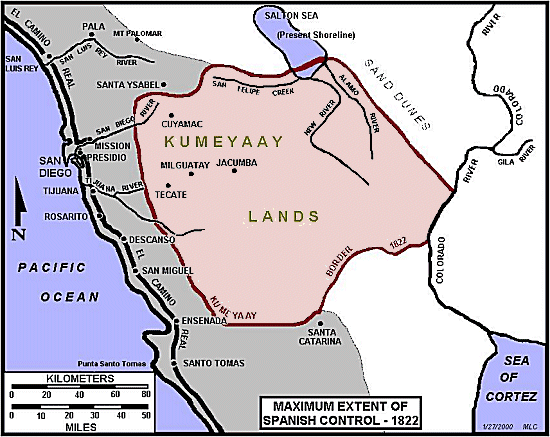 KUMEYAAY LANDS MAP 1822 Spanish Control in San DiegoThis Mike Connolly Miskwish, Campo-Kumeyaay website historical map "Maximum Extent of Spanish Control, 1822" highlights in gray the lost Kumeyaay and Indigenous tribal territories as of 1822 and the expanding Spanish colonization of the region. The Kumeyaay had been evicted from their prime coastal lands and resources, and pushed east into the much less productive desert mountain landscapes. LOST INDIGENOUS COASTAL LANDS By 1822, the Kumeyaay tribe had lost control of all of its ancestral coastal homelands to the Spanish immigrants. The immigrant Colonial Christian missionaries, conquistadors, explorers and settlers had quickly spread along the West Coast looking for the gold.... IT WOULD BE NAIVE to think the Spaniards' conquest was about anything other than finding the rumored Seven Cities of Gold Seven Cities of Cibola. Afterall, the Spanish Empire used the same model of invasion in 1519 when they plundered the Aztec Civilization's gold -- some 250 years earlier -- during the so-called global Age of Discovery (1489-1620). A STONE-AGE RESISTANCE: Historians speculate the Kumeyaay were living in the Late Prehistoric Period (the Stone Age) with no metal or cloth technology when they were "Discovered" in 1542 and Colonized by the Spanish Empire in the 1760s. In the 18th century -- when Spanish conquistadors went to war with the Kumeyaay Natives for their prime ancestral homelands, resources and freedom: It was Spanish steel swords, body armor, cannons and musket fire against primitive sticks and stones weaponry.
Eighteenth century tribal weaponry pictures period-style war clubs carved from local mesquite and hand painted with local Yuman tribal motifs using traditional red paint or red dye, cochineal (Dactylopius coccus). Respected Aboriginal ethnographic artist Nick Wilson CUCAPA handcrafted these unique museum-grade mesquite primitive war clubs around 2004 for museums, collectors and sale in the US-Mexico Border region.
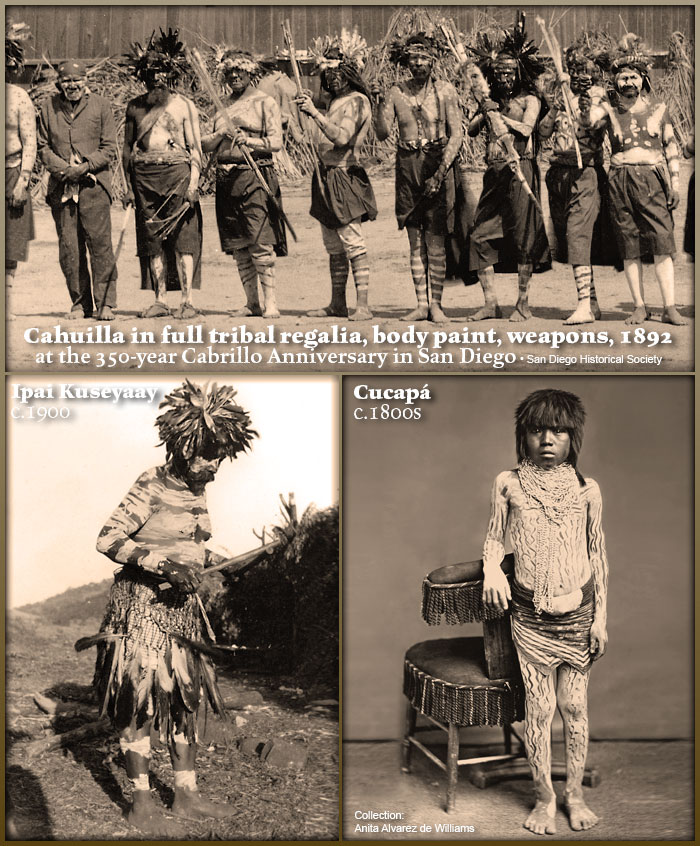
HOW DID THE ABORIGINAL TRIBESMEN APPEAR Back in the Day? I can imagine this is how the 16th and 18th century tribesmen appeared on the shorelines and villages of "Discovery" 1542, and "Invasion" (1760s):
Notice their full body, chest, face and leg paint, feathered headdresses, bandannas, lances, painted bows -- this is what authentic San Diego area male tribal regalia looks like... San Diego Indigenous CULTURE. Paul Campbell captioned the old 19th century studio photo: Painted Cocopa child. Note the design that results from scraping paint away with fingernails. Very old photograph. (From collection of Anita Alvarez de Williams.)
This historical map graphic is being used by the Kumeyaay Information Village website in its Kumeyaay History online sections.
Visit Mike Connolly's Kumeyaay band in the Smithsonian.
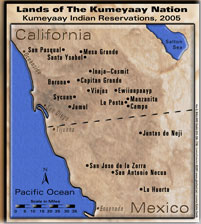
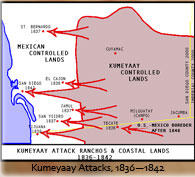
Five more MIKE CONNOLLY MISKWISH Campo Maps may be accessed here. These five historical Kumeyaay maps detail Kumeyaay points of history:
|
||||||||||||
| Terms of Use • Privacy Statement • Site Map Kumeyaay Indians Home • About Us • Mission Statement • Press Kit • Contact Us |
||||||||||||